Living Room Words in English for Kids
Living Room Words in English for Kids: Vocabulary and Activities starts with 24 everyday nouns, then builds short phrases, games, and home routines. Children name furniture, describe locations, and request items such as a cushion or remote control. School-age kids should practise six words at a time, adding more after two accurate rounds. Older learners can compare rooms, give directions, and explain each item’s purpose. Link every English word to an object, action, and one accurate sentence.
📥 Living Room Words in English for Kids
Learn, say, and use everyday living room vocabulary.
Leave your email — we'll send the PDF to your inbox.No spam — the PDF plus one short reminder. Unsubscribe anytime.
Essential Living Room Words
Teach six words per round: furniture, smaller items, then room parts. Point to each object. If it is absent, show a picture and explain its use.
Use Living Room Words in English for Kids: Vocabulary and Activities as a speaking set, not a spelling test. Pointing to a rug and saying “The rug is under the table” shows stronger English than copying a word without understanding it.
Useful Phrases and Examples in Context
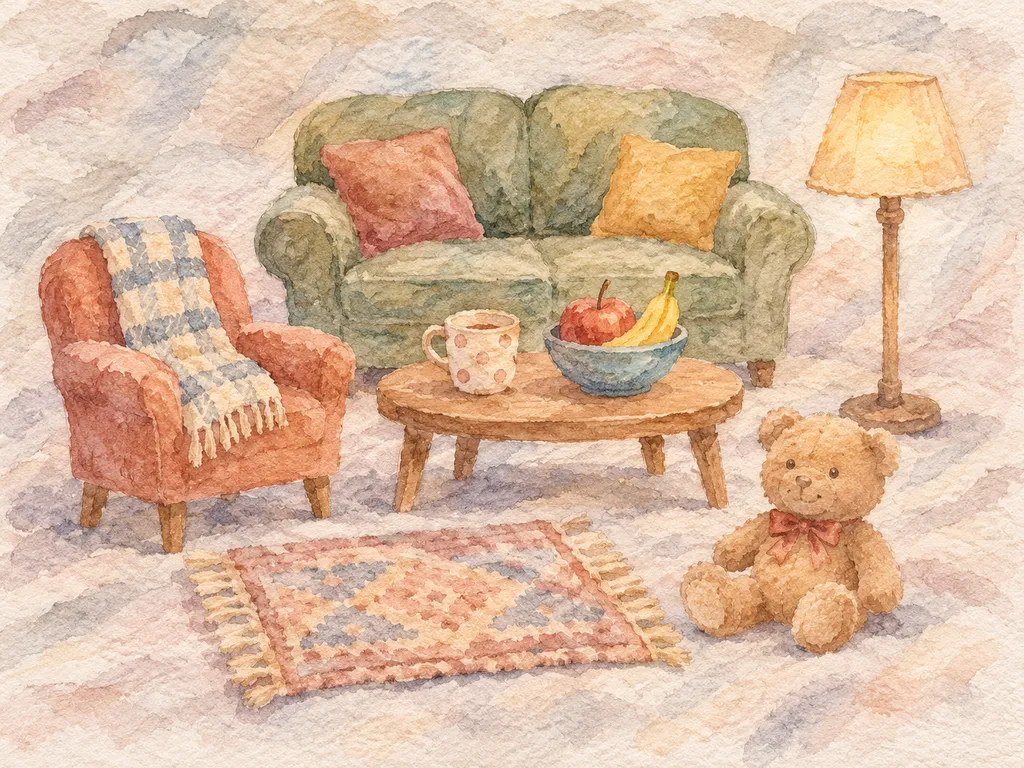
With Living Room Words in English for Kids: Vocabulary and Activities, practise one sentence pattern at a time: “This is a…”, “There is a…”, and “The ___ is on the ___.” Swap one noun: “The remote control is on the sofa,” “The cushion is on the armchair,” or “There is a plant by the window.”
Actions turn nouns into speech. Ask your child to open the curtains, switch on the lamp, pick up a cushion, or place a book on the shelf. Older children can describe a room: “There are two armchairs opposite the television, and a small table stands between them.” Accept regional terms such as sofa or couch.
How to Introduce the Vocabulary
Choose six objects in your living room. Say each word; your child points, then swap roles. Ask, “Where is the lamp?” Next require a full reply: “The lamp is next to the sofa.” The sequence moves practice from recognition to speech.
In a multilingual home, connect English to the object instead of testing one language against another. Your child may know several names for one item. Add the English label without marking other languages as errors. A removable label can support early recall; remove it once your child remembers the word unaided.
Activities for Different Ages
The same room supports four challenge levels. A Living Room Words in English for Kids: Vocabulary and Activities lesson changes the task, not the household items.
Keep each activity brief and accurate. Younger learners can repeat a favourite game; older learners need more choice. They might sketch an ideal living room, label it, and explain each object’s position. Artistic polish is unnecessary; the spoken description is the language task.
Practice Games at Home
Place safe living room objects or picture cards on a memory tray. Let your child look, cover the items, and remove one. Ask, “What is missing?” For a room hunt, give clues such as “Find something soft beside the sofa” or “Find something above the shelf.”
Three-minute Room Challenge
Choose six living room words. Your child points to each object and describes its place, colour, or use. Award one point for the right word and one for a complete sentence. Repeat later with two new words.
For quiet practice, take turns drawing a room while the other person gives instructions: “Draw a rug under the coffee table.” The game tests listening and vocabulary. Across LearnLink lessons, experienced tutors adjust prompts: beginners name items, while confident learners give reasons and longer descriptions.
Common Mistakes and Simple Corrections
Children may say “in the sofa” instead of “on the sofa,” though “in the armchair” works when the chair surrounds the person. Practise each phrase whole. Contrast “There is a lamp” with “There are two lamps.” For plurals, highlight forms such as shelves, which require more than adding s.
Regional English creates differences that are not mistakes. Sofa and couch name the same furniture; living room, lounge, and sitting room can describe the same space. Teach the term your child will probably hear, then introduce alternatives. Correct confusing meaning, but do not interrupt every sentence over accent or word choice.
- Point to five living room objects and say each English word clearly.
- Ask your child to repeat one word, then correct pronunciation gently.
- Match four word cards with the correct living room objects together.
- Use each new word in one simple sentence about your living room.
- Review confused words by pointing, naming, and repeating the correct answer.
When a word has several meanings or pronunciations, Cambridge Dictionary is a useful check before turning it into child-friendly examples.
Frequently Asked Questions
These answers set a manageable pace and address recurring questions during living room vocabulary practice.
How Many Living Room Words Should My Child Learn at Once?
When using Living Room Words in English for Kids: Vocabulary and Activities, start with six to eight words for a young beginner. Add words after your child can point to the objects and use them in short sentences. Older or experienced learners may handle a larger set, but recall and use matter more than finishing the table quickly.
Should My Child Learn “Sofa” or “Couch”?
Either word is correct. Choose one as the starting word and present the other as a regional alternative. Your child need not use both at once, but recognising both helps with books, videos, and conversations. Apply the same principle to “living room,” “lounge,” and “sitting room.”
Can We Practise If Our Living Room Has Different Furniture?
Yes. Begin with objects present in your home, even when the room is small or shared. Use pictures for unfamiliar items such as a fireplace or mantelpiece. Your child can compare the real room with a picture: “We have blinds, but this room has curtains.” The comparison keeps language concrete without assuming identical homes.
Should I Correct Every Vocabulary Mistake?
Correct mistakes that block meaning or recur. If your child says “The lamp is in the table,” reply, “Yes, the lamp is on the table,” then continue. Save longer explanations for practice time. Frequent interruptions break conversation; a direct model supplies the form needed for the next sentence.
Try this three-step plan today:
- Select six nouns from the table.
- Ask your child to point, name, and produce one location sentence for each noun; target six complete sentences in five minutes.
- Repeat tomorrow, adding two nouns only after five unaided recalls.
A short one-to-one lesson can show what level and pace fit your child — book a trial English lesson.
Stay updated on our latest tips and resources by following us on Instagram LearnLink.