Fire Station Words in English for Kids

A starter set of fire station English covers 24 words for people, places, vehicles, tools, sounds, and actions. Fire Station Words in English: Vocabulary and Activities for Kids presents that core set through play, pictures, movement, and short sentences. Begin with visible or active words: firefighter, helmet, hose, and ladder. Add phrases after the nouns become familiar. This sequence suits first-time online learners and multilingual children.
📥 Fire Station Words and Phrases
Learn useful vocabulary, speak in context, and practise safely at home.
Leave your email — we'll send the PDF to your inbox.No spam — the PDF plus one short reminder. Unsubscribe anytime.
Essential Words for a Fire Station Visit
When using Fire Station Words in English: Vocabulary and Activities for Kids, group words by meaning. Begin with people and places, then separate vehicles, clothing, and equipment. Categories build connections instead of an unrelated list.
The table contains 24 words. Regional names for vehicles and equipment vary, so accept the local term while teaching alternatives.
Useful Phrases in Context
Words become memorable inside sentences. In Fire Station Words in English: Vocabulary and Activities for Kids, frames such as “I can see…,” “The firefighter has…,” and “Where is…?” help children reuse one grammar pattern with different nouns.
Try picture talk: “I can see a fire engine. It is outside the fire station. The crew has a hose and a ladder.” Then ask questions with visible answers: “Where is the helmet?” “What makes a loud sound?” “Who checks the equipment?”
Older children can add sequence words: “First, the alarm sounds. Next, the crew gets ready. Then, the station doors open.” Keep the scene imaginary and calm. Practise English without copying emergency procedures.
Activities for Different Ages
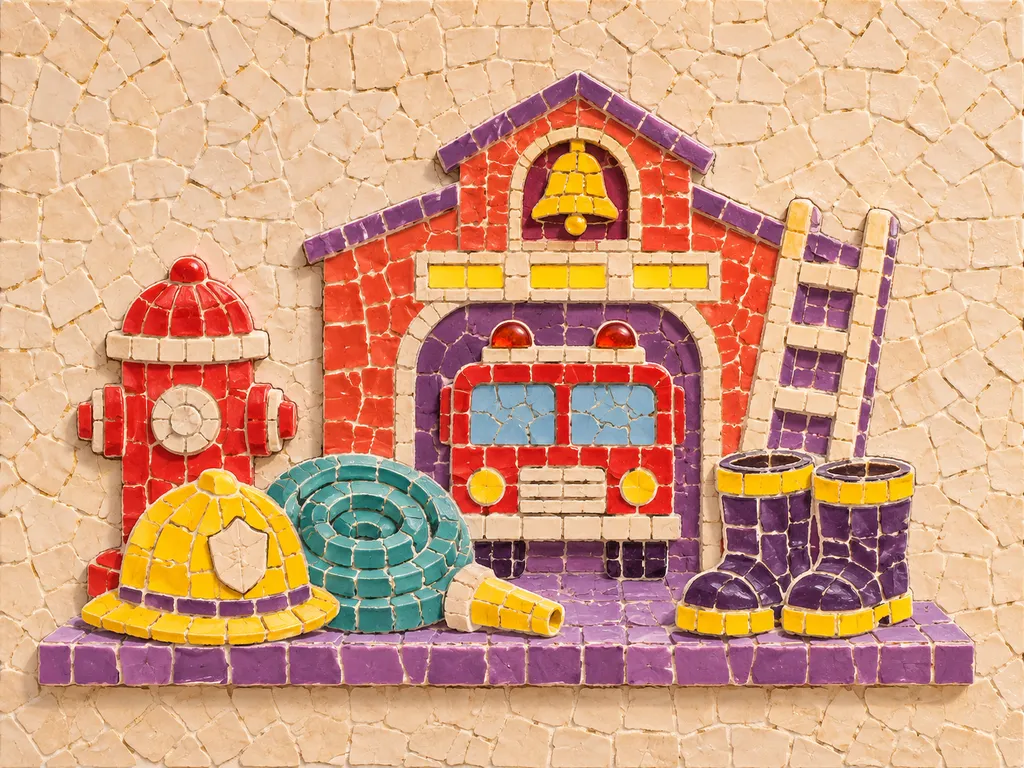
Adapt Fire Station Words in English: Vocabulary and Activities for Kids by changing the task rather than the vocabulary. Place four picture cards on the floor, say a word, and ask your child to point, step, or move a toy towards its card. Add one command: “Touch the helmet” or “Find the hose.”
Next, play “What is missing?” Display six cards, ask your child to close their eyes, and remove one. The child answers: “The ladder is missing.” For quiet practice, give a drawing direction: “Draw a red fire engine beside the station.”
For a harder task, create a short report, map, or dialogue. One learner describes the station while another labels a plan. Older children can compare fire engine, fire truck, and their country’s term. Regional variation is language knowledge, not an error.
Simple Practice at Home
Use five-minute practice rounds during the week. First, sort pictures into people, vehicles, clothing, and tools. Next, cover the labels and name each picture. Later, reverse the task: read a word, then ask your child to draw or describe it.
Multilingual children may connect an English word with one they know. After making the link, return to a complete English sentence: “A firefighter wears a helmet.” LearnLink tutors can adjust new vocabulary and speaking demands to the child’s level.
Build a Fire Station Scene
Choose eight items from the table. Draw a station scene containing all eight, then describe it without showing the picture. A partner listens and draws another version. Compare the pictures and identify precise instructions: “The ladder is on the fire truck,” or “The boots are beside the door.”
Common Mistakes to Correct Gently
Children may call every firefighter a fireman. Teach firefighter as the general term because it describes the job without gender. Acknowledge another known term, then model the new word in a sentence.
Fire station and fire engine are easy to confuse. The station is a building; the engine is a vehicle. Contrast them: “The fire engine leaves the fire station.” A picture showing both reinforces the difference.
Keep language practice separate from unsupervised safety practice. Children should not handle matches, alarms, hydrants, or extinguishers. Teach the local emergency number and safety steps from local fire-service guidance because procedures vary by country. Fire Station Words in English: Vocabulary and Activities for Kids supports calm recognition and communication.
- Choose three fire station words and model each pronunciation slowly without interrupting.
- Repeat the child’s sentence correctly, then invite one relaxed second attempt.
- Point to one picture and contrast firefighter, fire truck, and fire station.
- Praise clear meaning first, then correct only one vocabulary mistake at a time.
- Finish by reading one fire station book and revisiting corrected words together.
When a word has several meanings or pronunciations, Cambridge Dictionary is a useful check before turning it into child-friendly examples.
Frequently Asked Questions
How Many Fire Station Words Should My Child Learn at Once?
Start with four to six words for a younger beginner, adding more after recognition and use. An older learner may manage eight to ten. Treat Fire Station Words in English: Vocabulary and Activities for Kids as a sequence, not a test. Review familiar vocabulary while adding two or three new words.
What Is the Difference Between a Fire Engine and a Fire Truck?
Both terms describe firefighting vehicles, but usage varies by country and service. In certain places, an engine carries water and pumps, while a truck carries ladders and other equipment. Young learners need to recognise both terms and use the local one.
Should My Child Learn an Emergency Number with This Vocabulary?
Yes, but teach the number for your location rather than assuming one works everywhere. Explain its purpose and follow local emergency-service guidance. Keep practice separate from real calls: children can say the number, copy it onto a safety card, and rehearse information an operator may request.
How Can a Multilingual Child Remember These Words?
Connect each English word with a home-language word, image, gesture, or sound. Then practise the English item in a short sentence. Retain other languages. Move from recognition to recall in three steps: choose the correct picture, name it without a prompt, and use the word in a complete sentence.
Choose six words today. Practise for five minutes on three days this week, then ask your child to use at least four in a picture description. Add two new words after the first set becomes easy.
A short one-to-one lesson can show what level and pace fit your child — book a trial English lesson.
Stay updated on our latest tips and resources by following us on Instagram LearnLink.